Choosing salt tile thickness for your project
· 6 min read
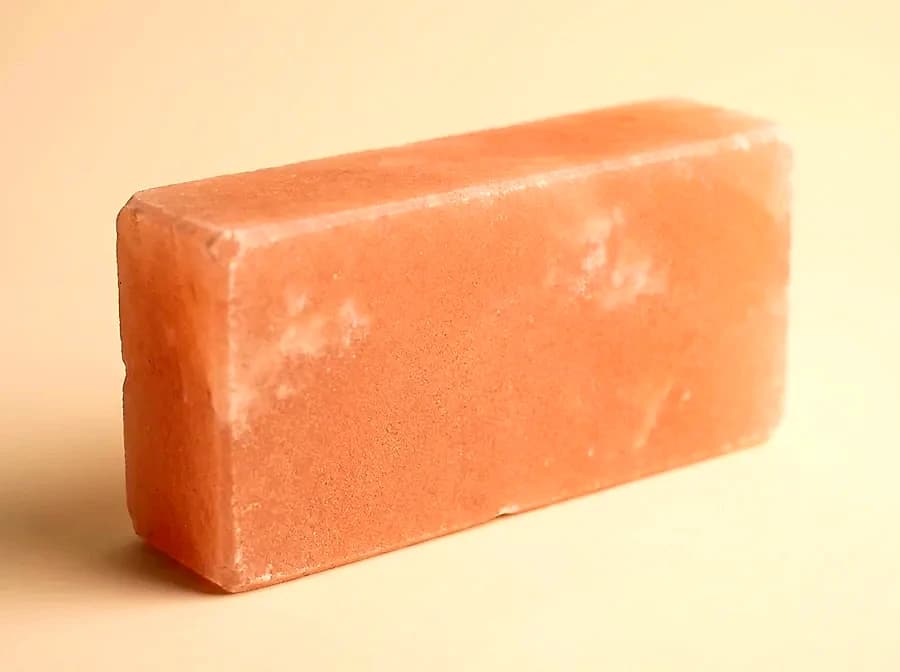
Thickness decides three things: how the wall is fixed, how it glows when lit, and how much it weighs per square metre. Getting it wrong is expensive — a wall specified too thin for backlighting looks flat, and one specified too thick for its substrate becomes a structural problem.
| Size | Weight each | Per m² | Load per m² | Best for |
|---|---|---|---|---|
| 8"×4"×1" | ≈ 1.5 kg | ≈ 45 pcs | ≈ 68 kg | Accent walls, ceilings, weight-limited substrates |
| 8"×4"×2" | ≈ 2.9 kg | ≈ 45 pcs | ≈ 131 kg | Standard salt rooms and saunas |
| 8"×4"×3" | ≈ 4.3 kg | ≈ 45 pcs | ≈ 194 kg | Deep backlit diffusion, heat retention |
| 8"×4"×4" | ≈ 5.8 kg | ≈ 45 pcs | ≈ 261 kg | Freestanding and load-bearing courses |
| 12"×8"×2" | ≈ 8.7 kg | ≈ 15 pcs | ≈ 131 kg | Large feature walls, fewer joints |
One inch: lightweight cladding
The economical way to cover a large area, and the only sensible choice on a substrate with limited load capacity or on a ceiling. It backlights brightly but with little depth — the glow sits on the surface rather than appearing to come from within the stone. Fine for a decorative accent, underwhelming for a feature wall people will stand in front of.
Two inch: the standard
The default specification for salt rooms and saunas, and our highest-volume line by a wide margin. Enough mass for thermal stability in a sauna, enough depth for a convincing backlit glow, and still light enough for vertical adhesive fixing on a properly prepared substrate. If you are unsure, this is the correct answer.
Three and four inch: depth and structure
Three inch gives noticeably richer backlit diffusion — light travels further through the crystal and the wall reads as glowing from inside. Four inch is a structural brick: use it where the wall is built rather than clad, such as a freestanding salt cave partition. At 261 kg per square metre, four-inch work needs engineering input, not just a tiler.
Check the load figures against your substrate before specifying. A 2 m × 3 m wall in four-inch brick is roughly 1.5 tonnes — that is a structural calculation, not a fixing decision.
Ordering overage
Add 7 to 10 percent for cuts and breakage. Beyond the practical need, batch colour varies: a repair made a year later from a fresh order will not match. Overage from the original batch is the only reliable way to keep a wall looking consistent over its life.
Looking for the commercial detail?
Compare all tile sizes