Himalayan salt vs sea salt: what actually differs
· 7 min read
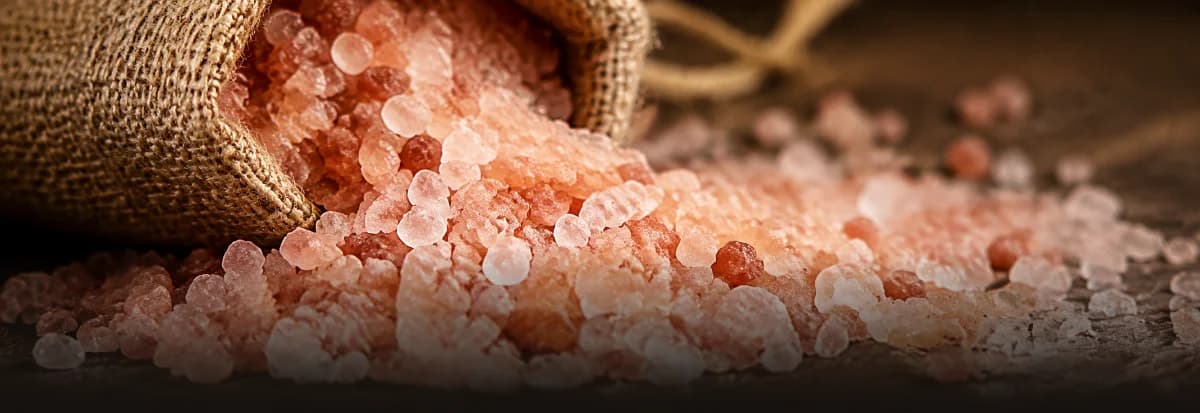
Both are sodium chloride. That is the honest starting point, and it is worth stating plainly because a great deal of marketing in this category implies otherwise. Himalayan pink salt is typically 96–99 percent NaCl; sea salt is usually 97–99 percent. The differences sit in the remaining one to four percent, in texture, and in how each is produced.
Origin
Himalayan salt is rock salt, mined from an ancient seabed in the Salt Range of Pakistan that was buried roughly 250 million years ago. Sea salt is produced by evaporating present-day seawater. That difference in age and isolation is the origin of the one genuinely meaningful distinction between them.
Contaminants
Because Himalayan salt was sealed underground long before industrial activity, it contains no microplastics. Multiple studies have found microplastic particles in a large majority of commercial sea salts sampled worldwide, which is a direct consequence of evaporating contemporary seawater. For brands whose positioning rests on purity, this is a defensible, evidence-backed point of difference — unlike most mineral claims.
| Himalayan pink salt | Sea salt | |
|---|---|---|
| Source | Mined rock, ~250 M years old | Evaporated modern seawater |
| NaCl content | 96–99 % | 97–99 % |
| Microplastics | None — pre-industrial deposit | Detected in most commercial samples |
| Colour | White to deep red (iron) | White to grey |
| Texture | Hard crystal, grinds cleanly | Flaky or moist, varies by method |
| Iodine | Trace, not significant | Trace, not significant |
The mineral claim, examined
Himalayan salt is often marketed as containing 84 trace minerals. The figure is broadly accurate as a count of detectable elements, but the quantities are minute — you would need to eat a physiologically dangerous amount of salt to obtain a nutritionally meaningful dose of any of them. We supply this product for a living and we will still tell you: buy it for taste, texture, appearance and purity of origin, not as a mineral supplement. Brands that lean hard on the nutrition angle are increasingly attracting regulatory attention.
Which to use commercially
- Retail grinder ranges — Himalayan, for the colour and the hard crystal that grinds without clogging
- Finishing salt — flake sea salt, for the crystal structure that dissolves on the tongue
- Bath and spa — Himalayan, for appearance in a clear jar and slow dissolution
- Industrial and de-icing — sea or lake salt, on cost
- Food manufacturing at scale — whichever is cheaper delivered, since neither is distinguishable once dissolved
The practical answer for most retail brands is that Himalayan salt sells better on shelf because it is visibly distinctive, and sea salt competes better on price. If your product is transparent-packaged and premium-positioned, colour is doing real commercial work.
Looking for the commercial detail?
Compare our edible grades